How to Start a Coffee Cart Business: Complete Guide 2025
The coffee cart industry represents one of the most accessible and profitable segments of mobile food service, with specialty coffee consumption growing 20% annually according to the Specialty Coffee Association. Coffee carts offer entrepreneurs a focused business model with lower startup costs than traditional cafes, predictable customer demand, and profit margins of 75-90% on premium beverages.
Starting a coffee cart business combines the growing demand for quality coffee with the flexibility and low overhead of mobile operations. This comprehensive guide covers everything you need to know about launching and operating a successful coffee cart business in 2025.
Table of Contents
- Why Coffee Carts Are a Smart Business Choice
- Understanding Your Coffee Cart Options
- Startup Costs and Financial Requirements
- Essential Equipment and Setup
- Location Strategy for Coffee Carts
- Menu Development and Pricing
- Legal Requirements and Permits
- Daily Operations and Management
- Marketing and Customer Acquisition
- Financial Management and Growth
- Common Mistakes to Avoid
- Your 90-Day Launch Plan
- Wrapping it up
Why Coffee Carts Are a Smart Business Choice
Coffee carts offer distinct advantages over both traditional coffee shops and other mobile food businesses, making them attractive for first-time entrepreneurs and experienced food service operators alike.
Market Opportunity and Growth
The mobile coffee market has expanded at 8.2% annually over the past five years, significantly outpacing traditional coffee shop growth. Americans spend over $45 billion on coffee annually, with mobile coffee operations capturing increasing market share through convenience, quality, and personalized service.
Key Market Advantages:
- Consistent demand – Coffee consumption remains stable year-round with only 15-20% seasonal variation
- Multiple revenue opportunities – Serve commuters, office workers, events, and special occasions
- Premium pricing potential – Quality coffee commands $4-8 per cup with minimal ingredient costs
- Growing specialty market – Consumers increasingly seek quality over convenience, favoring artisanal mobile operations
Business Model Benefits:
Lower Investment Requirements: Coffee carts require $16,000-$49,000 startup investment compared to $200,000-$500,000 for traditional coffee shops, making entrepreneurship accessible without substantial capital or debt.
Higher Profit Margins: Coffee generates 75-90% gross profit margins, significantly higher than most food service categories. A $5 latte costs approximately $0.75 to produce, enabling substantial profitability even with modest sales volumes.
Operational Flexibility: Mobile operations allow testing multiple locations, adjusting schedules based on demand, and adapting quickly to market changes without long-term lease commitments or fixed overhead.
Scalability Options: Successful single-cart operations can expand to multiple carts, transition to permanent locations, or develop franchise systems using proven business models and customer bases.
Understanding Your Coffee Cart Options
Coffee cart configurations vary significantly in size, capability, and investment requirements, making it essential to match cart type with your business model and target market. The right cart choice affects everything from your initial investment and operating costs to menu capabilities and revenue potential.
Choosing the wrong cart size is one of the most common mistakes new coffee cart operators make. A cart that’s too small limits menu options and creates operational inefficiencies during busy periods, while an oversized cart increases costs and reduces mobility without providing proportional revenue benefits. Understanding the trade-offs between different cart types enables informed decisions aligned with your specific business goals.
Cart Size and Configuration Options
Compact Push Carts ($6,000-$12,000):
Small, maneuverable units ideal for high-density urban areas, indoor venues, or locations with space constraints. These carts typically accommodate single-group espresso machines, basic grinders, and minimal storage, requiring frequent restocking throughout the day but offering maximum mobility and flexibility.
Dimensions: Typically 4′ x 6′ to 5′ x 7′ footprint
Weight: 200-400 pounds when fully loaded
Power Requirements: Can often operate on standard 110V power
Best for: Indoor locations, office building lobbies, small events, testing market demand before larger investment
Limitations: Limited menu options (usually 4-6 drink types), frequent restocking needs, minimal weather protection, single-operator only
Compact carts work exceptionally well for entrepreneurs starting part-time or testing locations before committing to larger investments. They’re also ideal for indoor venues like office buildings, hospitals, or covered markets where space is limited but foot traffic is consistent.
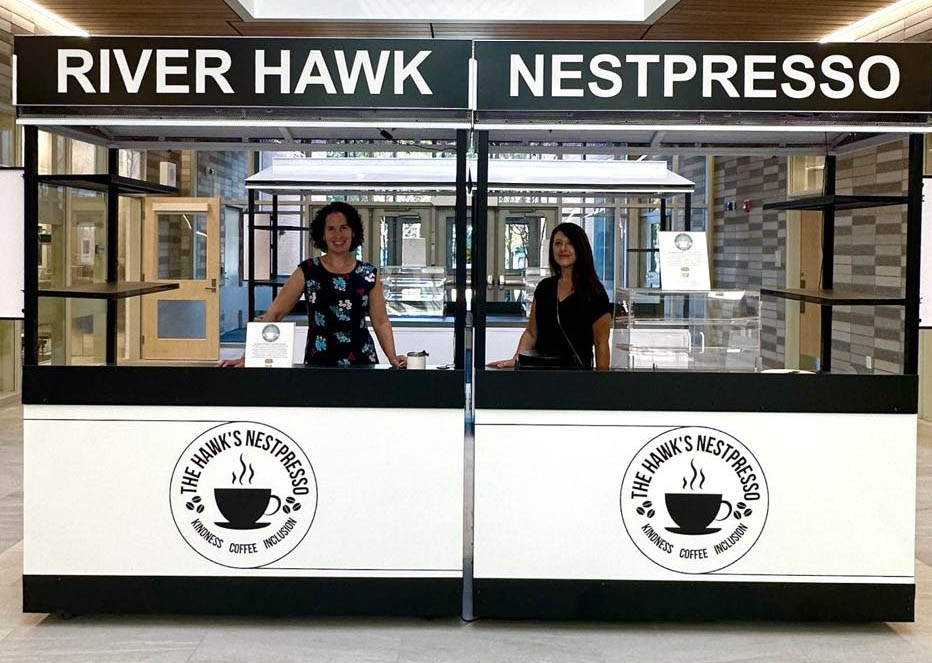
University of Massachusetts
Quad coffee cart in the atrium
Standard Coffee Carts ($10,000-$18,000):
Mid-size units providing the sweet spot between mobility and capability for most coffee cart operations. These carts include adequate storage for 4-6 hours of supplies, integrated weather protection, and space for two-group espresso machines enabling full specialty coffee service.
Dimensions: Typically 6′ x 8′ to 7′ x 10′ footprint
Weight: 500-1000 pounds when fully loaded
Power Requirements: Usually requires 220V or generator power for full equipment
Best for: Regular outdoor locations, farmers markets, business districts, event circuits
Advantages: Full espresso bar menu capability (8-12 drink types), reasonable storage reducing restocking frequency, integrated canopy for weather protection, space for add-on sales displays
Standard carts represent the most popular choice for serious coffee cart businesses because they balance capability with mobility. They provide sufficient space for quality equipment while remaining maneuverable enough for regular location changes and event participation.
Premium Coffee Trailers ($15,000-$35,000):
Larger towable units offering maximum capability including multiple espresso machines, extensive refrigeration and storage, built-in water tanks (20-40 gallons), and integrated power systems. These units enable high-volume service handling 100-200 customers per hour but require tow vehicles and more complex setup procedures.
Dimensions: Typically 8′ x 12′ to 8′ x 16′ enclosed trailers
Weight: 1,500-3,000 pounds requiring substantial tow vehicle
Power Requirements: Usually includes generator or requires significant shore power (30-50 amp)
Best for: High-volume events, festival circuits, corporate catering, multi-operator service, permanent or semi-permanent locations
Considerations: Requires tow vehicle ($15,000-$35,000), complex setup (30-60 minutes), higher permit costs, parking and storage challenges
Premium trailers suit established operators expanding into high-volume event service or entrepreneurs planning significant event and festival participation from the start. They’re also appropriate for locations where the trailer can remain semi-permanently, eliminating daily setup and breakdown.
Cart Features and Capabilities Comparison
Storage Capacity Impact: Compact carts hold 2-3 hours of supplies requiring mid-service restocking, standard carts accommodate 4-6 hours of supplies for full-day service, while trailers provide 8-12 hours or multi-day capacity for extended events.
Menu Complexity: Cart size directly limits menu options. Compact carts typically offer 4-6 drinks (basic espresso drinks, drip coffee, limited cold options). Standard carts support 8-12 drinks (full espresso menu, multiple cold options, seasonal specials). Trailers enable 12-20+ drinks (extensive menu, multiple brewing methods, food service).
Weather Operation: Compact carts require external canopies or umbrellas ($200-$500) for weather protection. Standard carts include integrated canopies providing operator and equipment protection. Trailers offer complete weather protection with enclosed service areas and climate control options.
Service Speed: Compact carts serve 10-15 customers per hour as single-operator limit. Standard carts handle 20-30 customers per hour with efficient workflows. Trailers support 40-60+ customers per hour with multiple operators and equipment stations.
New vs. Used Equipment Decisions
New Cart Advantages:
- Warranty coverage and manufacturer support
- Customization to exact specifications
- Latest equipment and technology
- No hidden maintenance issues
- Professional appearance from day one
Used Cart Considerations:
- 40-60% cost savings on initial investment
- Faster availability for quick startup
- Proven equipment in working condition
- Potential for unexpected repairs
- May require modifications for health compliance
Do you want to learn more about selecting the right platform? Explore our guide on coffee cart research and purchasing.
Startup Costs and Financial Requirements
Understanding complete startup costs prevents undercapitalization that causes 60% of food service business failures within the first year.
Initial Investment Breakdown
Essential Equipment and Cart ($13,000-$33,000):
- Coffee cart: $6,000-$18,000
- Commercial espresso machine: $2,000-$8,000
- Commercial grinder: $300-$1,200
- Espresso kit (water system): $400-$800
- Refrigeration: $600-$2,000
- POS system and supplies: $500-$1,000
- Initial branding and signage: $500-$2,000
Legal and Administrative ($800-$2,500):
- Business licenses and permits: $300-$1,500
- Health department permits: $200-$600
- Insurance (first year): $300-$400
Initial Inventory and Supplies ($800-$1,500):
- Coffee beans and supplies: $300-$600
- Cups, lids, and service items: $200-$400
- Milk and dairy products: $100-$200
- Syrups and add-ons: $100-$200
- Pastries and complementary items: $100-$100
Working Capital ($2,000-$5,000):
- 3-6 months operating expenses
- Marketing and promotion budget
- Emergency equipment repair fund
- Cash flow buffer for seasonal variations
Total Investment Range: $16,600-$49,000
For complete cost breakdowns, financing options, and detailed budget planning, see our comprehensive Coffee Cart Startup Costs Guide
Monthly Operating Expenses
Fixed Costs ($375-$935 monthly):
- Commissary kitchen rental: $200-$500
- Insurance: $25-$35
- Phone and internet: $50-$100
- Storage (if needed): $100-$300
Variable Costs (percentage of sales):
- Coffee and supplies: 25-30% of revenue
- Permits and locations: $200-$800 monthly
- Fuel and transportation: 3-5% of revenue
- Equipment maintenance: 2-4% of revenue
- Credit card processing: 2.5-3.5% of revenue
Essential Equipment and Setup
Equipment quality directly affects product consistency, operational efficiency, and customer satisfaction, making informed purchasing decisions crucial for success. The difference between commercial-grade and consumer equipment isn’t just durability, but the ability to maintain consistent performance during peak service periods when customers expect quick service and reliable quality.
Poor equipment choices create cascading problems including inconsistent drink quality that prevents premium pricing, frequent breakdowns during busy periods that lose customers and revenue, excessive maintenance costs that erode profitability, and inability to scale operations as business grows. Conversely, investing in appropriate commercial equipment enables consistent quality that justifies $5-8 pricing, reliable performance during 50-100 drink morning rushes, and professional appearance that builds customer confidence and brand reputation. The initial equipment investment typically represents 30-40% of total startup costs, making it the largest single expense category but also the most critical factor in determining operational success and customer satisfaction.
Core Coffee Equipment
Commercial Espresso Machine: The heart of your operation affecting both quality and service speed. Look for dual boiler systems enabling simultaneous espresso extraction and milk steaming, consistent temperature control, and commercial durability.
Budget-Conscious Options ($2,000-$4,000): Reliable machines from brands like Rancilio Silvia Pro or Breville Dual Boiler offer commercial features at accessible prices for startups.
Professional Grade ($4,000-$8,000): La Marzocco Linea Mini, Nuova Simonelli Appia, or similar machines provide exceptional consistency and durability for high-volume operations.
Commercial Coffee Grinder: Fresh grinding dramatically impacts coffee quality, making a commercial burr grinder essential rather than optional. Choose grinders with stepless adjustment, large hoppers for peak periods, and consistent particle size distribution.
Recommended Options: Mazzer Mini ($600-$900), Baratza Sette 270 ($400-$500), or Compak E8 ($800-$1,200) offer commercial reliability at various price points.
Espresso Kit and Water Systems: Mobile operations require independent water supply and drainage systems that don’t depend on permanent plumbing. Essential components include fresh water reservoirs (5-10 gallon capacity), electric pumps maintaining consistent pressure, waste water collection, and filtration systems ensuring water quality.
System Benefits: Independent water systems enable operation anywhere without plumbing requirements, provide consistent water quality regardless of location, and ensure health department compliance for mobile service.
For detailed equipment comparisons, specifications, and purchasing guidance, explore our complete Coffee Cart Equipment Guide
Supporting Equipment Needs
Refrigeration and Storage: Under-counter refrigeration units designed for mobile operations with adequate capacity for daily milk needs, reliable temperature control meeting health codes, and energy efficiency for generator or battery power.
Power Management: Coffee equipment requires significant electrical power through shore power connections, generator systems, or battery systems with inverters. Consider total equipment wattage, operating duration, and location power availability when planning power systems.
Organization and Workflow: Efficient cart layout minimizes movement during service, positions equipment for logical workflow from order to delivery, and creates professional appearance that justifies premium pricing.
Location Strategy for Coffee Carts
Location selection significantly impacts revenue potential, with prime spots generating $400-$600 daily while poor locations struggle to reach $100-$150 daily sales. This dramatic difference means location choice can determine whether your coffee cart generates $100,000+ annually or barely covers operating expenses, making systematic location analysis one of the most critical success factors for mobile coffee operations.
Unlike brick-and-mortar cafes that can eventually build customer bases through consistent presence, coffee carts depend on intercepting existing foot traffic patterns rather than creating destination demand. A coffee shop in a mediocre location can succeed through marketing, atmosphere, and time, but a coffee cart in the wrong location will fail regardless of coffee quality, service excellence, or pricing strategy. The mobility advantage of coffee carts becomes meaningless if operators cannot identify, access, and secure the high-traffic locations where customers naturally congregate during coffee consumption times.
Successful location strategy requires understanding that coffee sales concentrate during specific time periods (6:30-9:30 AM accounts for 60-70% of daily revenue for most carts), meaning locations must provide adequate traffic during these narrow windows rather than just general daily foot traffic. A busy shopping district with strong afternoon traffic may generate disappointing revenue if morning commuter traffic is minimal, while a business park that appears empty most of the day can be highly profitable due to concentrated morning activity.
Business Districts and Office Complexes:
Morning commuters and office workers provide consistent demand during peak coffee hours (6:30-9:30 AM and 12:00-2:00 PM). These locations offer opportunities for regular customers, predictable schedules, and steady revenue streams.
Revenue Potential: $200-$500 daily depending on employee count and accessibility
Peak Hours: 7:00-9:00 AM (60-70% of daily revenue), 12:00-2:00 PM (20-30% of revenue)
Customer Average: $4-6 per transaction with regular customer loyalty
College and University Campuses:
Students and faculty create steady demand throughout academic years with different patterns than business locations. Campus locations allow extended hours and provide opportunities for late-night service during study periods.
Seasonal Considerations: Revenue drops 50-70% during summer sessions and breaks
Customer Behavior: Frequent small purchases, price-sensitive, social media active
Partnership Opportunities: Exclusive vendor agreements, event catering, exam period promotions
Medical Facilities and Hospitals:
Healthcare workers, patients, and visitors create consistent demand throughout the day including early morning and late evening hours other locations cannot support.
Advantages: 24/7 customer base, shift worker demand, loyal healthcare professional customers
Challenges: Strict health compliance, competitive application processes, parking logistics
Transit Hubs and Commuter Locations:
Train stations, bus stops, and park-and-ride facilities capture commuters seeking convenient coffee during transportation routines.
Success Factors: Understanding transit schedules, positioning for maximum boarding visibility, quick service capabilities
Peak Windows: 6:30-9:00 AM and 4:30-7:00 PM aligned with transportation schedules
For comprehensive location analysis methods, traffic studies, and multi-location strategies, read our detailed Coffee Cart Location Guide
Location Analysis Process
Traffic Pattern Studies: Conduct systematic pedestrian counts during different times and days, observing peak periods, customer demographics, and purchasing behavior patterns that indicate revenue potential.
Competition Assessment: Map existing coffee options within walking distance, noting operating hours, pricing strategies, and apparent customer satisfaction to identify market gaps and positioning opportunities.
Permit Research: Understand local regulations, application processes, and costs before investing time in location development. Some areas have permit caps or seasonal restrictions that make seemingly ideal locations impractical.
Explore more in the article Best Coffee Cart Locations: Where to Set Up for Maximum Profit
Menu Development and Pricing
Coffee cart menus must balance customer expectations with operational efficiency while maximizing profit margins through strategic item selection and pricing.
Core Menu Structure
Essential Espresso Drinks: Cappuccino, latte, americano, and macchiato satisfy most customer preferences using similar ingredients with different proportions, simplifying inventory management and staff training.
Drip Coffee Options: High-quality drip coffee serves price-conscious customers and traditional coffee preferences. Offering regular and decaf options with seasonal blend rotations maintains interest and quality perception.
Cold Coffee Selections: Iced coffee, cold brew, and iced espresso drinks become essential during warm weather and appeal to younger demographics willing to pay premium prices for specialty cold preparations.
Seasonal and Specialty Items: Limited-time offerings create excitement, enable premium pricing, and test customer preferences for potential permanent menu additions.
Pricing Strategy
Market-Based Positioning: Research local coffee shop pricing to position competitively while accounting for convenience advantages. Coffee cart pricing typically ranges from 10-20% below brick-and-mortar shops while maintaining higher margins due to lower overhead.
Profit Margin Targets:
- Drip coffee: 85-90% gross margin
- Espresso drinks: 75-85% gross margin
- Specialty beverages: 80-90% gross margin
- Add-on items: 60-70% gross margin
Psychological Pricing: Size-based pricing encouraging upselling (12oz $4.50, 16oz $5.25, 20oz $5.75) creates value perception while increasing average transactions.
For complete menu engineering strategies, seasonal planning, and profitability optimization, explore our Coffee Cart Menu and Pricing Guide
Legal Requirements and Permits
Coffee cart operations require various permits ensuring food safety compliance while enabling legal operation in chosen locations.
Business Registration
Federal Requirements: Obtain EIN (Employer Identification Number) from IRS.gov for tax purposes and business banking.
State Requirements: Business license registration, sales tax permits for collecting and remitting taxes, and state-specific food service licenses where applicable.
Local Permits: City or county business licenses, local tax registrations, and municipality-specific operating permits.
Health Department Compliance
Mobile Vendor Permits: Health department permits specific to mobile food operations including initial application, plan review, cart inspection, and ongoing compliance monitoring.
Application Requirements: Detailed equipment specifications, menu descriptions, operational procedures documentation, and commissary kitchen agreements.
Inspection Standards: Temperature control procedures, sanitation protocols, hand washing facilities, and waste disposal systems meeting local health codes.
Location Permits
Vending Permits: Required for operation on public property with daily ($25-$100), monthly ($200-$800), or annual ($1,000-$5,000) options depending on jurisdiction and operational strategy.
Private Property Agreements: Written permission from property owners for private property operations including insurance requirements, operational terms, and revenue sharing arrangements (typically 10-20% of sales).
Event Permits: Additional permits for festivals, markets, and special events often requiring advance applications (6+ months) and specific insurance coverage.
Daily Operations and Management
Efficient operations ensure consistent quality while maximizing revenue during peak demand periods when customers expect quick service and reliable products. Coffee cart profitability concentrates during narrow time windows when operational efficiency becomes critical to capturing maximum revenue opportunity. A cart serving 40 customers during the morning rush generates significantly more revenue than one serving 25 customers during the same period, not just through higher sales volume but through customer retention when people learn they can rely on quick service.
Poor operational efficiency creates cascading problems during peak periods including long wait times causing customer abandonment, rushed service leading to quality inconsistencies that prevent repeat business, and operator stress that affects customer interactions and service atmosphere. Service speed during peak hours directly determines daily revenue potential because limited foot traffic windows mean missed customers cannot be recovered later in the day.
Successful coffee cart operators develop systematic procedures that enable consistent 2-3 minute service times even during busy periods, maintain quality standards regardless of volume pressure, and create workflows that minimize wasted motion and maximize customer throughput. These operational systems become even more critical when training employees or expanding to multiple carts, as documented procedures enable consistent execution across different operators and locations. The difference between efficient and inefficient operations often means a 30-50% revenue difference from the same location and customer base.
Daily Operational Flow
Opening Procedures (5:30-7:00 AM):
- Equipment setup and warmup (espresso machine requires 20-30 minute warmup)
- Inventory verification and preparation
- Cart positioning for optimal customer flow
- POS system initialization and payment processing verification
Peak Service Management (7:00-9:30 AM):
- Efficient drink preparation following standardized recipes
- Customer service maintaining 2-3 minute service targets
- nventory monitoring and mid-service restocking
- Equipment maintenance and calibration during service gaps
Afternoon Service (11:00 AM-3:00 PM):
- Continued quality standards with afternoon customer preferences
- Menu emphasis on specialty and cold drinks during warm weather
- Customer relationship building during slower periods
Closing Procedures (3:00-5:00 PM):
- Equipment cleaning and sanitization per health requirements
- Inventory accounting and waste documentation
- Cash reconciliation and banking
- Cart security and transportation to storage
Quality Control Standards
Consistent Brewing Parameters: Water temperature (195-205°F), espresso extraction time (25-30 seconds), grind size consistency, and milk steaming techniques ensuring reliable products regardless of operator experience.
Ingredient Management: Coffee bean rotation using roast dates, milk quality monitoring, and syrup replacement schedules maintaining product quality while controlling waste.
Equipment Calibration: Regular pressure verification, grinder adjustment, and temperature checks ensuring consistent extraction and product quality throughout service periods.
Marketing and Customer Acquisition
Coffee cart marketing focuses on building local awareness, encouraging trial, and developing loyalty through consistent quality and personalized service.
Building Your Brand
Brand Identity Development: Create recognizable branding communicating quality, convenience, and personality resonating with target customers through professional logo design, consistent color schemes, and memorable cart appearance.
Visual Consistency: Ensure all customer touchpoints including cart design, menu boards, cups and packaging, and social media presence maintain unified brand experience building recognition and trust.
Digital Marketing Strategy
Social Media Presence: Build following through regular posting on Instagram (visual appeal), Facebook (community engagement), and Twitter (real-time location updates) that keeps your cart top-of-mind for customers.
Content Strategy: Daily location updates, behind-the-scenes preparation, customer features and testimonials, seasonal drink announcements, and coffee education providing value beyond promotional content.
Local SEO: Optimize Google My Business profile, encourage customer reviews, and maintain accurate location information ensuring local search visibility when potential customers search for coffee options.
Customer Retention
Loyalty Programs: Implement punch card systems, mobile app point accumulation, or subscription services rewarding repeat customers while collecting behavioral data for marketing optimization.
Personalized Service: Learn regular customers’ names and drink preferences creating personal connections encouraging loyalty and word-of-mouth referrals that reduce customer acquisition costs.
Community Engagement: Participate in local events, support community organizations, and develop partnerships with nearby businesses building local reputation and expanding customer reach.
Financial Management and Growth
Sound financial management enables sustainable operations while providing foundation for strategic growth and expansion opportunities. The coffee cart industry’s high gross margins (75-90%) create a false sense of profitability that masks operational inefficiencies, inadequate cost tracking, or unsustainable pricing strategies that slowly erode actual profits. Many coffee cart operators generate strong revenue but fail due to poor financial discipline including failure to account for all operational costs, inadequate cash reserves for seasonal fluctuations or equipment repairs, and expansion decisions based on gross revenue rather than actual profitability.
Successful operators track detailed financial metrics daily, maintain accurate cost percentages, and make data-driven decisions about pricing, locations, and growth investments. According to industry research, coffee carts that implement systematic financial tracking and analysis achieve 35-50% higher profitability than those relying on intuition or basic revenue tracking alone. This financial discipline becomes even more critical when considering expansion, as poor financial management in a single cart operation multiplies problems when scaling to multiple locations or larger operations.
Key Performance Indicators
Daily Metrics to Monitor:
- Gross sales and customer count
- Average transaction amount
- Sales by time period (identifying peak hours)
- Product mix and best-selling items
- Cash versus card payment ratios
Weekly Analysis:
- Compare performance to previous weeks and seasonal patterns
- Evaluate location performance and customer traffic changes
- Monitor cost percentages and profitability trends
- Adjust inventory and staffing based on patterns
Revenue and Profitability Targets
Realistic Revenue Expectations:
- Startup phase (months 1-3): $150-$250 daily
- Established operations (months 4-12): $250-$400 daily
- Optimized operations (year 2+): $350-$600 daily
Profitability Timeline:
- Target break-even by month 3-4
- Net margins: 5-15% during startup, 15-25% after optimization, 20-30% at maturity
Growth Strategies
Single Cart Optimization: Perfect operations, customer relationships, and profitability before considering expansion. Most successful operators spend 12-18 months optimizing single-cart operations before growth.
Multi-Cart Expansion: Add carts for different locations or increased capacity requiring $15,000-$25,000 investment per additional cart plus manager hiring and training.
Service Expansion: Develop corporate catering, event services, subscription programs, or wholesale coffee sales creating diversified revenue streams reducing dependence on cart operations.
Permanent Location Transition: Use cart success as proof-of-concept for brick-and-mortar coffee shop, leveraging established customer base and operational experience for traditional cafe development.
Common Mistakes to Avoid
Learning from typical coffee cart mistakes saves time, money, and prevents business failures that could be avoided through proper planning.
Equipment and Setup Errors
Underinvesting in Equipment: Purchasing inadequate espresso machines or grinders compromises product quality making premium pricing impossible and customer retention difficult.
Solution: Invest in commercial-grade equipment meeting volume and quality requirements even if requiring slightly higher initial investment. Equipment quality directly affects revenue potential and customer satisfaction.
Ignoring Power Requirements: Inadequate power systems cause equipment failures during peak service periods, losing customers and revenue.
Solution: Calculate total equipment wattage and ensure power systems provide 20-30% surplus capacity for reliability and equipment protection.
Location and Operations Mistakes
Insufficient Location Research: Choosing locations based on casual observation rather than systematic traffic studies leads to revenue shortfalls and business struggles.
Solution: Conduct proper traffic counting, demographic analysis, and competition assessment before committing to locations or permit investments.
Inconsistent Service Quality: Variable drink quality or service inconsistency prevents customer loyalty despite ideal locations.
Solution: Develop standardized recipes, training procedures, and quality control systems ensuring consistency regardless of operator experience or business conditions.
Financial Planning Errors
Undercapitalization: Starting with minimum required capital leaves no buffer for unexpected expenses or slower-than-expected customer acquisition.
Solution: Maintain 6 months operating expenses as working capital beyond equipment and permit costs, ensuring business survival during startup challenges.
Poor Cost Tracking: Not monitoring ingredient costs and waste percentages allows profit erosion that threatens sustainability.
Solution: Implement daily cost tracking, waste documentation, and regular financial analysis identifying problems before they become critical.
Your 90-Day Launch Plan
A systematic implementation timeline ensures thorough preparation while maintaining momentum toward opening day. Most successful coffee cart operators spend 8-12 weeks between initial planning and first customer service, with this timeframe providing adequate preparation without losing entrepreneurial momentum or market opportunities. Rushing the launch process by attempting to open in 4-6 weeks often results in permit delays, inadequate training, or equipment problems that create poor first impressions with potential regular customers. Conversely, extending preparation beyond 16 weeks frequently causes analysis paralysis, unnecessary expense from overthinking decisions, and missed seasonal opportunities when customer traffic peaks.
The 90-day timeline balances thoroughness with action, dividing implementation into three distinct phases: planning and preparation, setup and procurement, and launch and optimization. Each phase builds on previous accomplishments while maintaining forward progress toward opening day. This structured approach prevents overlooked requirements that cause operational delays while ensuring all legal, financial, and operational foundations are properly established before serving your first customer.
Phase 1: Planning and Preparation (Days 1-30)
Week 1: Research and Business Planning
- Complete market research and competitor analysis
- Develop business plan and financial projections
- Choose business structure and begin registration
- Research equipment options and suppliers
Week 2: Legal and Financial Setup
- File business registration and obtain EIN
- Research permit requirements and begin applications
- Contact insurance agents for coverage quotes
- Establish business banking relationships
Week 3: Equipment Research
- Visit suppliers and test espresso machines
- Compare equipment options and negotiate pricing
- Research coffee suppliers and roasters
- Plan cart customization and branding
Week 4: Location Development
- Conduct traffic studies at potential locations
- Begin permit application processes
- Negotiate private property agreements
- Finalize location strategy and schedules
Phase 2: Setup and Procurement (Days 31-60)
Week 5-6: Equipment Acquisition
- Purchase cart and major equipment
- Arrange installation and testing
- Order initial inventory and supplies
- Begin branding installation
Week 7-8: Training and Testing
- Complete barista training
- Test all equipment and procedures
- Refine recipes and service procedures
- Conduct trial operations with feedback
Phase 3: Launch and Optimization (Days 61-90)
Week 9-10: Soft Opening
- Begin limited operations at primary location
- Test procedures and customer flow
- Gather feedback and refine processes
- Build initial customer relationships
Week 11-12: Full Operations
- Expand to full operating schedule
- Implement marketing and promotional activities
- Monitor performance and adjust
- Plan expansion to additional locations
Wrapping it up
Coffee cart businesses offer exceptional opportunities for entrepreneurs seeking profitable, flexible operations with lower barriers to entry than traditional cafes. Success requires systematic planning, quality equipment investment, strategic location selection, and commitment to operational excellence that builds customer loyalty.
Key Success Principles
Quality Focus: Invest in proper equipment and training delivering consistently excellent coffee that justifies premium pricing and encourages repeat business.
Strategic Planning: Thorough market research, financial planning, and location analysis prevent common mistakes while identifying best opportunities.
Operational Excellence: Efficient procedures, consistent quality standards, and excellent customer service create competitive advantages supporting sustainable profitability.
Customer Relationships: Personal service and community engagement create loyal customer bases providing stable revenue and reducing marketing costs through word-of-mouth referrals.
Financial Discipline: Conservative planning, accurate tracking, and strategic investments enable long-term success while avoiding pitfalls causing business failures.
Your Next Steps
Begin with thorough market research identifying opportunities in your area. Develop realistic financial projections and secure adequate funding preventing undercapitalization that threatens survival.
Invest in quality equipment enabling consistent product delivery within budget constraints. Focus on operational efficiency and customer service excellence creating positive experiences encouraging loyalty.
Build relationships with customers, suppliers, and community partners supporting sustainable growth while maintaining personal touches differentiating mobile operations from impersonal chains.
Most importantly, remember that coffee cart success comes from consistent daily execution rather than dramatic innovations. Customer loyalty develops through reliable quality and service meeting expectations every visit.
Ready to dive deeper into specific aspects of starting your coffee cart? Explore our detailed guides on equipment selection, startup costs, location strategy, and menu development for comprehensive planning resources.

What you can read next